History
Elizabeth history: a sawmill camp, a railroad, and two buildings that were nearly lost
A timber camp on the Palmer Divide named for a governor's relative, a post office in 1882, incorporation in 1890, a bank that closed in the Depression and waited a century for the National Register, and a sculptor who saved the oldest building on Main Street.
Elizabeth starts with timber. The ponderosa forest along the Palmer Divide was the nearest standing sawtimber to a Denver that was building itself out of wood, and by the 1860s there were sawmill camps working the hills where the town now stands. The settlement took the name Elizabeth from a relative of John Evans, the second territorial governor of Colorado, whose Denver and New Orleans Railroad would later run its track past the mills.
The post office and the railroad
The Denver and New Orleans reached the divide in 1882, and the same year, on 24 April, Elizabeth got a post office, which is the date the town generally treats as its founding. The railroad is why the town is where it is: the line needed a section crew stationed here to keep the track, and the 1882 Section House built for them still stands, restored in 2002. Elizabeth incorporated on 9 October 1890.
What followed was the ordinary arc of a Front Range prairie town. The timber thinned and the economy turned to cattle, wheat and potatoes on the surrounding tableland. Main Street filled in with brick and false-front commercial buildings serving farms and ranches for twenty miles in every direction, and the town settled into a size it would hold, more or less, for a century: a few hundred people, a school, a rail siding, a grain business and a bank.
Two buildings
Two of those buildings carry most of the town’s surviving history, and both came close to being lost.
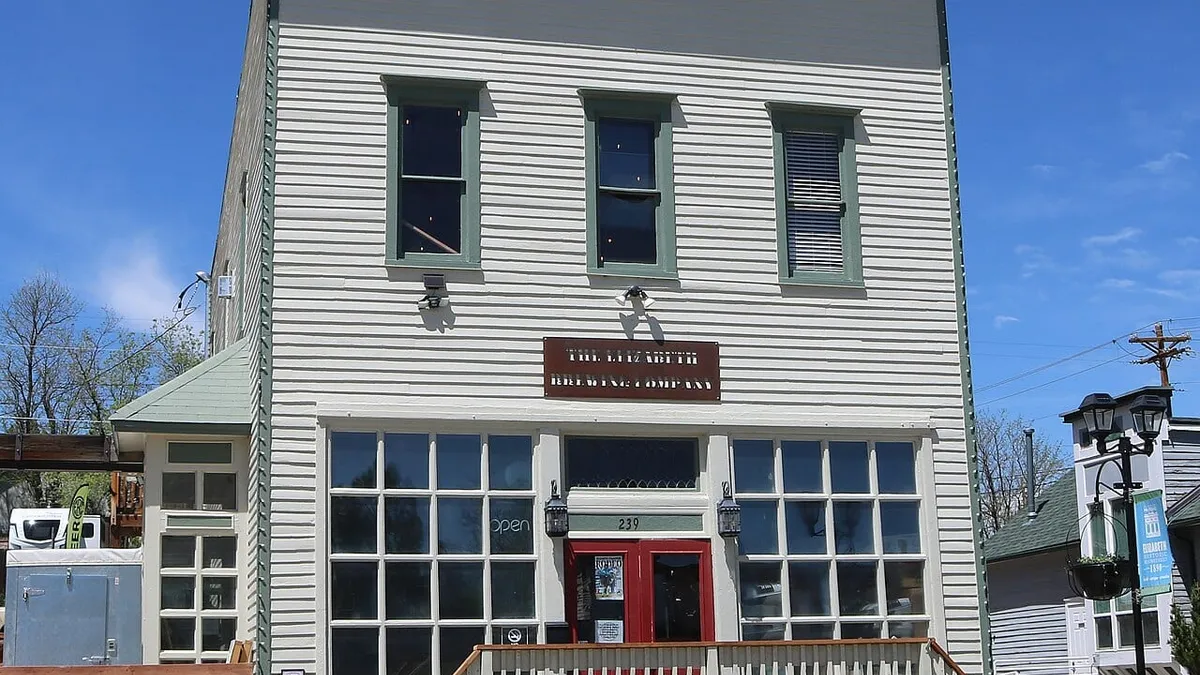
The Huber-Carlson Building at 239 South Main is the oldest commercial building in Elizabeth, put up around 1890 on foundations that go back to 1882. It went on the Colorado State Register of Historic Properties in 1995. Its second name comes from the sculptor George Carlson, who bought it in 1971 and used it as a studio, and the building’s survival through the decades when nobody wanted a two-storey brick block on a prairie main street is largely his doing. It now holds the Elizabeth Brewing Company, which means the oldest room in town is also the busiest one on a Friday night.
The First National Bank of Elizabeth at 188 South Main was built in 1907, in the confident years when a town of this size expected to keep growing. It failed in the Depression, like most small-town banks on the plains, and the building spent the rest of the century in other uses. It was listed on the National Register of Historic Places in March 2023, more than ninety years after the bank itself stopped existing.
Deciding to keep it
The interesting part of Elizabeth’s recent history is that the town chose, deliberately and fairly early, to hold on to its Main Street rather than let it be replaced.
The Board of Trustees adopted a historic preservation ordinance and created a Historic Advisory Board in 1998. In 2012 the town put interpretive plaques on the Main Street buildings, so the dates and the original uses are readable from the pavement. In 2015 Elizabeth became a Certified Local Government, which brings state preservation money and review standards, and the Elizabeth Main Street Program is a designated Colorado Main Street community, with the sidewalk, crossing and facade work that comes with that designation.
That is why two blocks of brick storefronts survive in a town that is otherwise growing outward very fast.
The growth
The 2020 census counted 1,675 people in Elizabeth, an increase of 23.34 percent over 2010. Estimates for 2026 put the town closer to 3,100, which has repeatedly placed Elizabeth among the fastest-growing municipalities in the country by percentage. The pressure comes from the north and west: Parker, Castle Rock and the Douglas County commute are all inside forty-five minutes, and five-acre parcels on the divide are cheaper than anything comparable closer in.
The consequence, argued at most Board of Trustees meetings, is water. Elizabeth sits on the Denver Basin aquifers with no river to speak of, and every annexation is finally a question about how much water the town has and for how long. It is the oldest subject in this part of Colorado and the one that will decide what Elizabeth looks like in thirty years.
Sources
- Elizabeth, Colorado, Wikipedia, for the founding dates, incorporation, elevation and census figures.
- Historic Elizabeth on the Section House, the preservation ordinance, the 2012 plaques and Certified Local Government status.
- History Colorado: First National Bank of Elizabeth and the National Register nomination form.
- Elizabeth Brewing Company on the Huber-Carlson Building, for the 1890 construction, the State Register listing and George Carlson.
- Elizabeth Main Street Program, for the Colorado Main Street designation.